NASA is in full knowledge that microgravity deteriorates the human body. Numerous NASA studies have shown that exercise speeds up the process of deterioration, yet they continue to advise astronauts to exercise frequently in space.
Spaceflight causes infertility. Egg cells die. Sperm cells die.
Without the downward pull of the Earth’s gravity, blood does not flow downwards. Instead blood pools in the upper regions of the body, including the face, nicknamed ‘fat face and chicken legs’. The skull stretches and becomes elongated and the brain drifts upward. The entire skeletal frame stretches. The limbs stretch. The neck stretches. All the stretching causes bones to become porous and calcium is lost. The loss of calcium increases with the length of time spent in space and continues to be lost after return to Earth. Calcium loss takes place at 10 times the rate of an elderly person suffering from osteoporosis.
Lack of gravity causes DNA to unwind, veins and arteries to stretch and become narrower resulting in anemia and a reduction in blood cell count.
Muscular tissue is lost due to nitrogen depletion.
Space travel causes blindness. Research performed on the International Space Station shows prolonged time in space can cause temporary, and sometimes permanent, blindness, said Julie Robinson, the chief scientist of the International Space Station. Space travel damages the function of the eye and deforms shape of the eye and optic nerve.
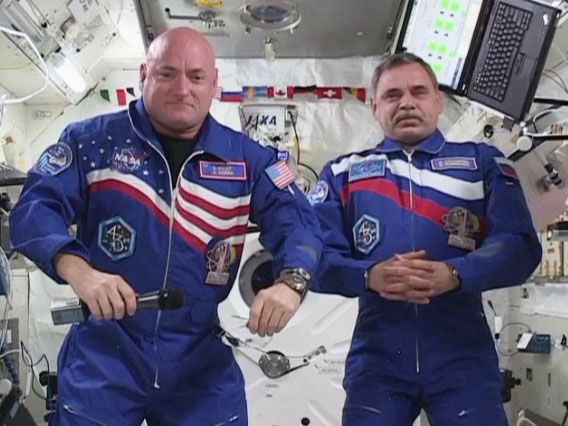
“When I returned after 340 days [in space], I was surprised at how differently I felt compared to my previous long-duration mission of 159 days. My muscles more quickly stiffened and my skin was extremely sensitive and became inflamed. I developed a hive-like rash on every surface of my skin that came in contact with. My legs were swollen due to the shift of fluid gravity forced upon my body. I even had flu-like symptoms that appear to have been a result from my extended time in space.”
~ Scott Kelly, Retired Astronaut, testimony before the Subcommittee on Science, Space and Technology, U.S. House of Representatives, 15 June 2016

