At 9:10 pm on August 25, 1951, Dr. W. I. Robinson, professor of geology at the Texas Technological College, stood in the backyard of his home in Lubbock, Texas and chatted with two colleagues. The other men were Dr. A. G. Oberg, a professor of chemical engineering, and Professor W. L. Ducker, head of the department of petroleum engineering.
The night was clear and dark. Suddenly all three men saw a number of lights race noiselessly across the sky, from horizon to horizon, in a few seconds. They gave the impression of about 30 luminous beads, arranged in a crescent shape. A few moments later another similar formation flashed across the night.
This time the scientists were able to judge the light moved through 30 degrees of arc in a second. A check the next day with the Air Force showed that no planes had been over the area at that time. This was but the beginning: Professor Ducker observed 12 flights of the luminous objects between August and November.
Some of his colleagues observed as many as 10. Hundreds of non-scientific observers in a wide vicinity around Lubbock saw as many as three flights of the mysterious crescents in one night.
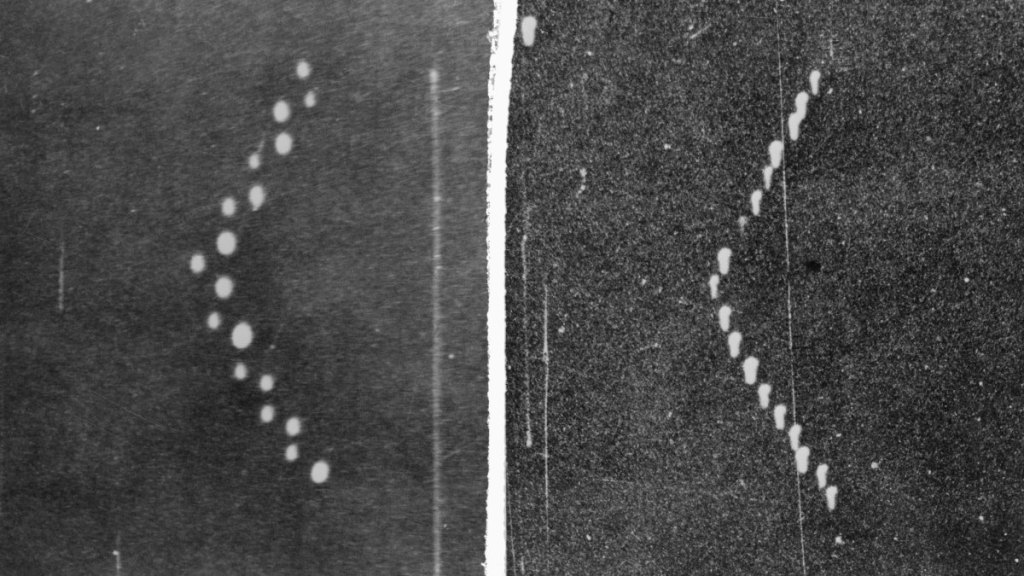
On the night of August 30 an attempt to photograph the light was made by 18-year-old Carl Hart Jr.. He used a Kodak 35mm camera at f3.5 1/10 of a second. Working rapidly, Hart managed to get five exposures of the flights.
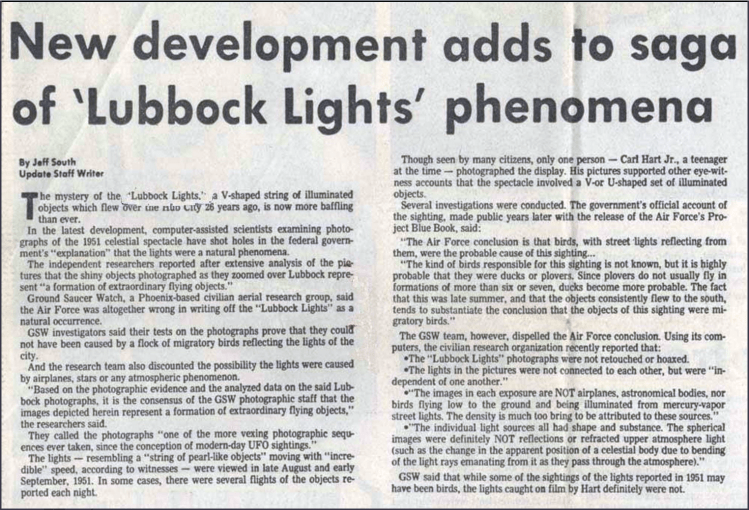
The picture exhibited by Hart show 18 to 20 luminous objects, more intense that the planet Venus, arranged in one or a pair of crescents. In several photographs, off to one side of the main flight, a larger luminosity is visible… like a mother craft hovering near its aerial brood.
The photographs were taken at 5:30pm and 10:37pm. The three Texas Tech professors examined the 18-year-old’s photographs, but could find no explanation for the photos. Witness Roger Dods heard a slight rustling or whooshing sound as the objects passed overhead. He reported seeing them at 10:37pm. In late September a report of the Lubbock Lights reached the Air Force.


Leave a Reply