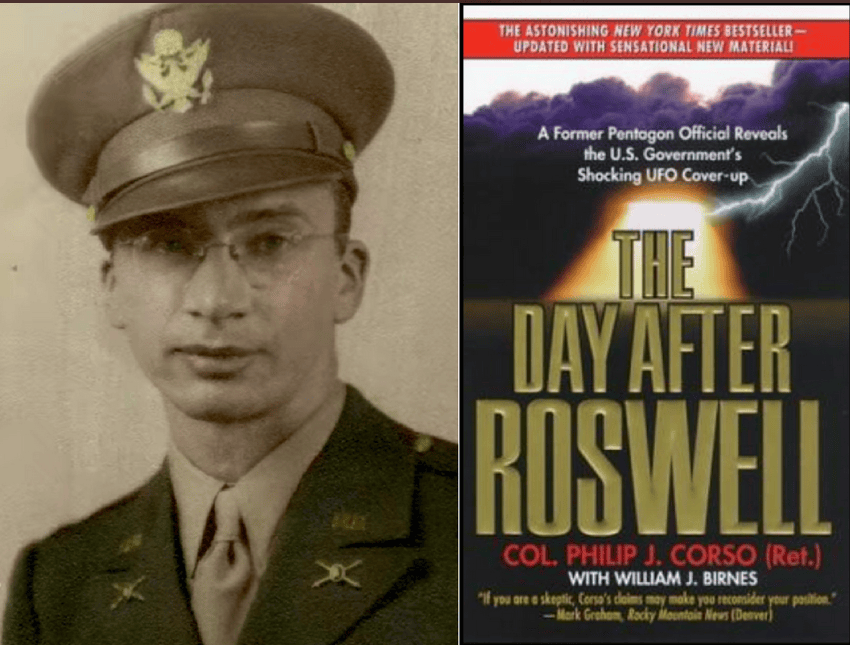
[Below are excerpts from Colonel Philip J Corso’s book ‘The Day After Roswell’.]
What happened after Roswell, how we turned the extraterrestrials’ technology against them, and how we actually won the Cold War is an incredible story. During the thick of it, I didn’t even realize how incredible it was. I just did my job, going to work at the Pentagon, day in and day out until we put enough of the alien technology into development that it began to move forward under its own weight through industry and back into the army.
The Crash
Base radar at the army’s 509th airfield outside the town of Roswell had been tracking strange blips all night on July 1, 1947. So had radar at nearby White Sands, the army’s guided missile base where test launches of German V2 rockets has been taking place since the end of the war, and at the nuclear-testing facility at Alamogordo.
The radar anomalies continued into the next night as Dan Wilmot, owner of a hardware store in Roswell, set up chairs on his front porch after dinner to watch the streaks of lightening flash across the sky in the distance. Shortly before ten that evening, the lightening grew more intense and the ground shook under the explosions of thunder from a summer storm that pounded the chaparral off in the northwest of the city. Dan and his wife watched the spectacle from beneath the dry safety of their porch roof. It was as if each new bolt of lightening were a spear that rent the heavens themselves.
The isolated incidents of unidentified radar blips at Roswell and White Sands continued to increase over the next couple of days until it looked like a steady stream of airspace violations. Now it was becoming more serious. There was no denying that a traffic pattern of strange aircraft overflights was emerging in the skies over the New Mexico desert where, with impunity, these unidentifiable radar blips hovered above and then darted away from our most secret military installations. By the time the military’s own aircraft scrambled, the intruders were gone. It was obvious to the base commanders that they were under a heavy surveillance from a presence they could only assume was hostile. At first, nobody gave much thought to the possibility of extraterrestrials or flying saucers, even though they’d been in the news for the past few weeks that spring.
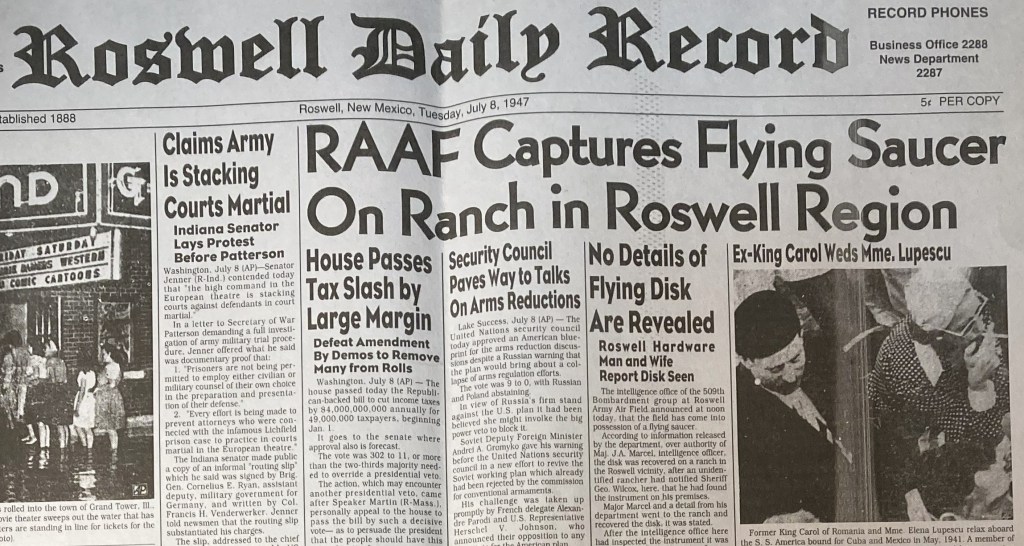
On the evening of July 4, 1947 while the rest of the country was celebrating Independence Day radar operators at site around Roswell noticed that the strange objects were turning up again. They were pulsating – it was the only way you could describe it – glowing intensely, then dimly, as tremendous thunderstorms broke out over the desert. Steve Arnold, posted to the Roswell airfield control tower that the evening, had never seen a blip behave like that as it darted across the screen between sweeps at speeds over a thousand miles an hour. All the while it was pulsating, throbbing almost, until, while the skies over the base exploded in a biblical display of thunder and lightening, it arced to the lower left-hand quadrant of the screen, seemed to disappear for a moment, then exploded in a brilliant white fluorescence and evaporated right before his very eyes.
The screen was clear. The blips were gone. And as controllers looked around at each other and at the CIC officers in the room, the same thought arose in all their minds: An object, whatever it was, had crashed. The military response was put into motion within seconds.
This was a national security issue – jump on that thing in the desert and bring it back before anyone else could find it.
And by four-thirty that morning, a single pumper and police car were bouncing through the desert taking Pine Lodge Road west to where Sheriff Wilcox had directed them. Neither the sheriff nor the fire department knew that a military retrieval team was also on its way to the site with orders to secure the location and, by any means necessary, prevent unauthorized dissemination of any information about the crash.
It was still dark when, from the other direction, Steve Arnold, riding shotgun in one of the staff cars in the convoy of recovery vehicles from the 509th, reached the crash site first. Even before their trucks rolled into position, an MP lieutenant from the first jeep posted a picket of sentries, and an engineer ordered his unit to string a series of floodlights around the area. The Arnold’s car pulled up, and he got his own first glimpse of the wreckage.
In the stark light of military searchlights, Arnold saw the entire landscape of the crash. He thought it looked like a crash landing because the craft was intact except for a split seam running lengthwise along the side and the steep forty-five-plus-degree-angle of the craft’s incline. He assumed it was a craft, even though it was like no airplane he’d ever seen. It was small, but it looked more like the flying wing shape of an old Curtis than an ellipse or saucer. And it had two tail fins on the top sides of the delta’s feet that pointed up and out. He angled himself as close to the split seam of the craft as he could get without stepping in front of the workers in hazardous-material suits who were checking the site for radiation, and that was when he saw them in the shadow. Little dark gray figures – maybe four, four and a half feet in length – sprawled across the ground.
“Are those people?” Arnold heard someone say as medics rushed up with stretchers to the knifelike laceration along the side of the craft through which the bodies had either crawled or tumbled.
Arnold looked around the perimeter of light and saw another figure, motionless but menacing nevertheless, and another leaning against a small rise in the desert sand. There was a fifth figure near the opening of the craft. As radiation technicians gave the all-clear and medics ran to the bodies with stretchers, Arnold sneaked a look through the rip in the aircraft and stared out through the top.
Through the top of the craft, as if he were looking through a lens, Arnold could see and eerie stream of light, not daylight or lamplight, but light nevertheless. He’d never seen anything like that before and thought that maybe this was a weapon somebody had developed.
The scene at the crash site was a microcosm of chaos. Technicians with specific tasks, such as medic, hazardous-material sweepers, signalmen and radio operators, and sentries were carrying out their jobs methodically.
“Hey, this one’s alive,” Arnold heard, and turned around to see one of the little figures struggling on the ground. With the rest of the medics, he ran over to it and watched as it shuddered and made a crying sound that echoed not in the air but in his brain.
“Halt!” the sentry screamed at the small figure that had gotten up and was trying desperately to climb over the hill.
“Halt!” the sentry yelled again and brought his M1 to bear. Other soldiers ran toward the hill as the figure slipped in the sand, started to slide down, caught his footing, and climbed again. The sound of soldiers locking and loading rounds in their chambers carried loud across the desert.
“No!” one of the officers shouted. Arnold couldn’t see which one, but it was too late.
There was a rolling volley of shots from the nervous soldiers, and as the small figure tried to stand, he was flung over like a rag doll and then down the hill by the rounds that tore into him. He lay motionless on the sand as the first three soldiers to reach him stood over the body, chambered new rounds, and pointed their weapons at his chest.
“Arnold,” the officer spit again. “Arnold.” Steve Arnold snapped to attention. “You and your men get out there and stop those civilians from crossing the perimeter.” He motioned to the small convoy of emergency vehicles approaching them from the east. He knew they had to be police or county sheriff. Then he called out. “Medics.”
Arnold jumped to at once, and by the time the medics were loading the gray creature on a stretcher, he was already setting up a perimeter of CIC personnel and sentries to block the site from the flashing lights and churning sand far in the distance to the south of them. He heard the officer order the medics to load the bodies on stretchers, pack them in the back of whatever two-and-a-half-ton GMC he could pull off the line, and drive them back to the base immediately.
“Sergeant,” the officer called out again. “I want your men to load up everything that can be loaded on these deuce-and-a-halfs and sway the damn… whatever it is” – he was pointing to the delta-shaped object – “on this low-boy and get it out of here. The rest of you,” he called out. “I want this place spotless. Nothing every happened here, you understand? Just a nothing piece of scrub bush like the rest of this desert.”
“You guys can head on back,” Dwyer heard the captain tell one of the Roswell police officers on the scene. “We’ve go the area secured.”
“What about injuries?” the police officer asked, maybe thinking more about the incident report he had to fill our than about what to do with any casualties.
“No injuries. We have everything under control,” the captain said.
But even as the military was waving off the civilian convoy, Dwyer could see small bodies being lifted on stretchers from the ground into army transport trucks. A couple of them were already in body bags, but one, not bagged, was strapped directly onto the stretcher. The police officer saw it, too. This one, Dwyer could tell, was moving around and seemed to be alive. He had to get closer.
“What about them?” he asked.
Dwyer took off his fire helmet, climbed down from the truck, and worked his way through the shadows around the flank of the line of MPs. There was so much confusion at the site Dwyer knew no on would notice if he looked around. He walked around in the back of the truck, across the perimeter, and from the other side of the military transport truck walked up to the stretcher. He looked directly down into the eyes of the creature strapped onto the stretcher and just stared.
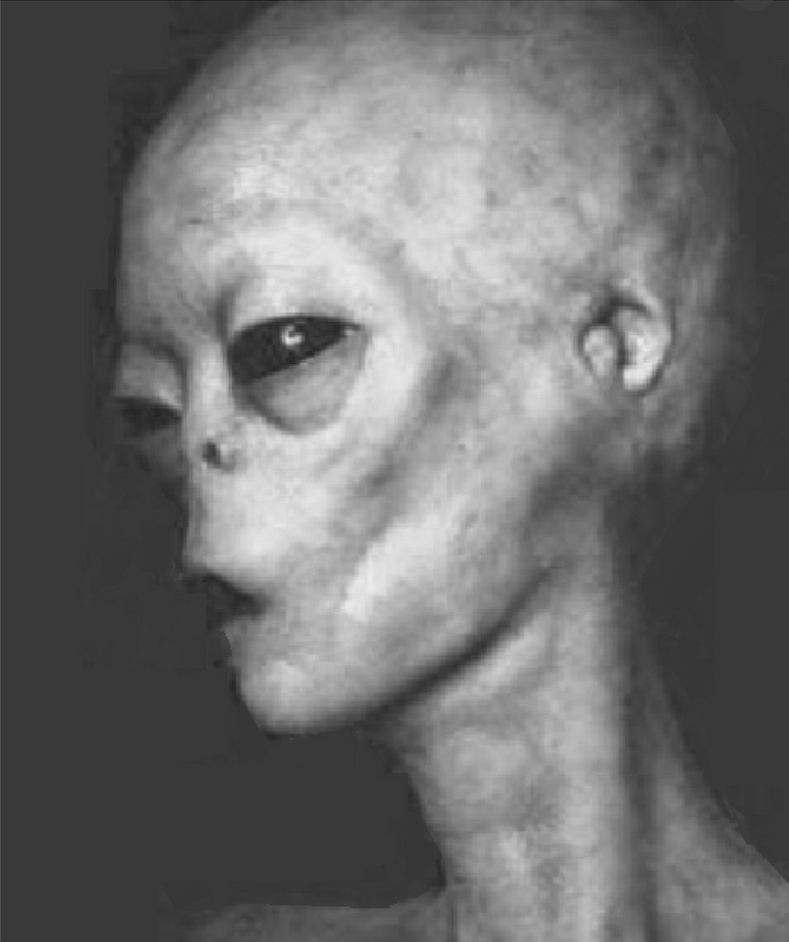
It was no bigger than a child, he thought. But it wasn’t a child. No child had such an oversized balloon-shaped head. It didn’t even look human, although it had humanlike features.
It’s eyes were large and dark, set apart from each other on a downward slope. It’s nose and mouth were especially time, almost like slits. And its ears were not much more than indentations along the sides of its huge head. In the glare of the floodlight, Dwyer could see the creature was grayish brown and completely hairless.


Leave a Reply